
Texas Bankruptcy Court Records
Texas bankruptcy records are public federal court documents filed in one of four United States Bankruptcy Court districts that cover the state. Whether you need to look up a case by name, find a filing date, or get copies of court documents, the main tool is PACER, the federal court's online public access system. Each of the four Texas districts keeps its own docket, and cases are searchable by party name, case number, and filing date. This guide covers how to find Texas bankruptcy records, what those records contain, and which court handles filings in your area.
Texas Bankruptcy Records Overview
Texas Bankruptcy Court Districts
Bankruptcy in Texas falls under federal jurisdiction. That means all cases go through federal courts, not state courts. Texas has four federal bankruptcy districts, and every one of the state's 254 counties falls under one of them. Each district has its own clerk's office, judges, and local rules. Knowing which district covers your county is the first step to finding bankruptcy records.
The Northern District of Texas is the largest. It covers 100 counties in northern and central Texas. The main office sits at the Earle Cabell Federal Building, 1100 Commerce Street, Dallas. The court also has offices in Fort Worth, Amarillo, Lubbock, Abilene, San Angelo, and Wichita Falls. If you want basic case information for free, call the Voice Case Information System at 866-222-8029. It runs 24 hours a day and requires no account.
The Southern District of Texas covers 43 counties in the southern part of the state. Its main office is at 515 Rusk Street in Houston, phone (713) 250-5500. The district has seven divisions: Houston, Corpus Christi, Galveston, Brownsville, Laredo, McAllen, and Victoria. The Houston Division handles more bankruptcy cases than any other division in the state.
The Eastern District of Texas covers 43 counties in the eastern region. The court is based in Tyler at 211 West Ferguson Street, with offices in Beaumont and Plano. It has six divisions: Beaumont, Lufkin, Marshall, Sherman, Tyler, and Texarkana. Chief Judge Brenda Rhoades handles cases from Sherman and Texarkana, while Judge Joshua P. Searcy presides over Beaumont, Lufkin, Marshall, and Tyler cases. The clerk of court is Jason K. McDonald, reachable at 972-509-1240.
The Western District of Texas covers 68 counties in central and western Texas. The main office is in San Antonio at 615 E. Houston Street, Room 597, phone 210-472-6720. Clerk of Court is Yvette M. Taylor. Chief Judge Ronald B. King leads this court along with Judges H. Christopher Mott, Tony M. Davis, and Craig A. Gargotta. Divisions include San Antonio, Austin, El Paso, Waco, and Midland. The Midland division is unstaffed, meaning no permanent clerk's office is there, and its cases are handled through San Antonio or Austin.
Note: The district your county belongs to is where your bankruptcy case is filed and where records are stored. Use the county pages on this site to find which district covers your area.
The federal court's public access portal, PACER, is the primary tool for searching Texas bankruptcy records online across all four districts.
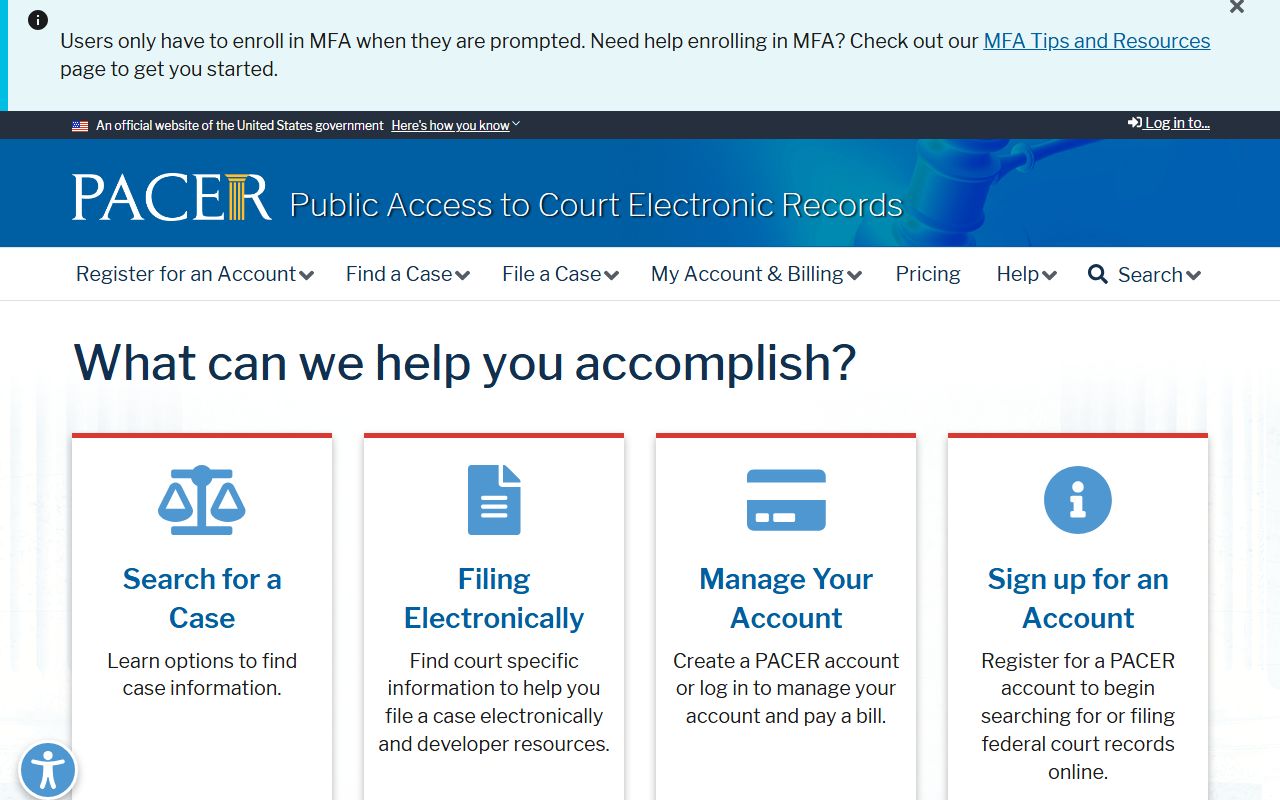
After creating a free PACER account, you can search all Texas bankruptcy courts by debtor name, case number, or filing date, and view case dockets and filed documents for a small per-page fee.
How to Search Texas Bankruptcy Records
PACER, which stands for Public Access to Court Electronic Records, is the main way to search Texas bankruptcy records online. It gives you access to case dockets, filed documents, and party information from all four Texas bankruptcy courts. Registration is free. You can sign up at pacer.uscourts.gov. If you provide a credit card at registration, you get same-day access. Register without a card and login details arrive by mail within about a week. Once in, use the PACER Case Locator to search across all Texas districts at once or go to a specific court site for more detailed results.
PACER charges $0.10 per page for documents you view or download, with a $3.00 maximum per document. Court opinions are free. If your total charges in any quarter stay under $30.00, those fees are waived. The PACER fee schedule is set by the Judicial Conference of the United States. Fee waivers are also available for courts, federal agencies, bankruptcy trustees, and researchers on defined scholarly projects.
If you just need basic case details, the Voice Case Information System (VCIS) is free and available around the clock. For the Northern District, call 866-222-8029. You can get the case number, filing date, and general status over the phone without creating a PACER account. Each district has its own VCIS number.
In-person access is also available. Every clerk's office lobby has public terminals that let you search the court's database at no charge. Staff can help you locate a case by name or number. For old cases filed before courts went digital, roughly pre-1999, paper records may be stored at a Federal Records Center or at the National Archives facility in Fort Worth.
The Northern District of Texas Bankruptcy Court in Dallas covers 100 counties and is the largest of the four Texas bankruptcy districts.
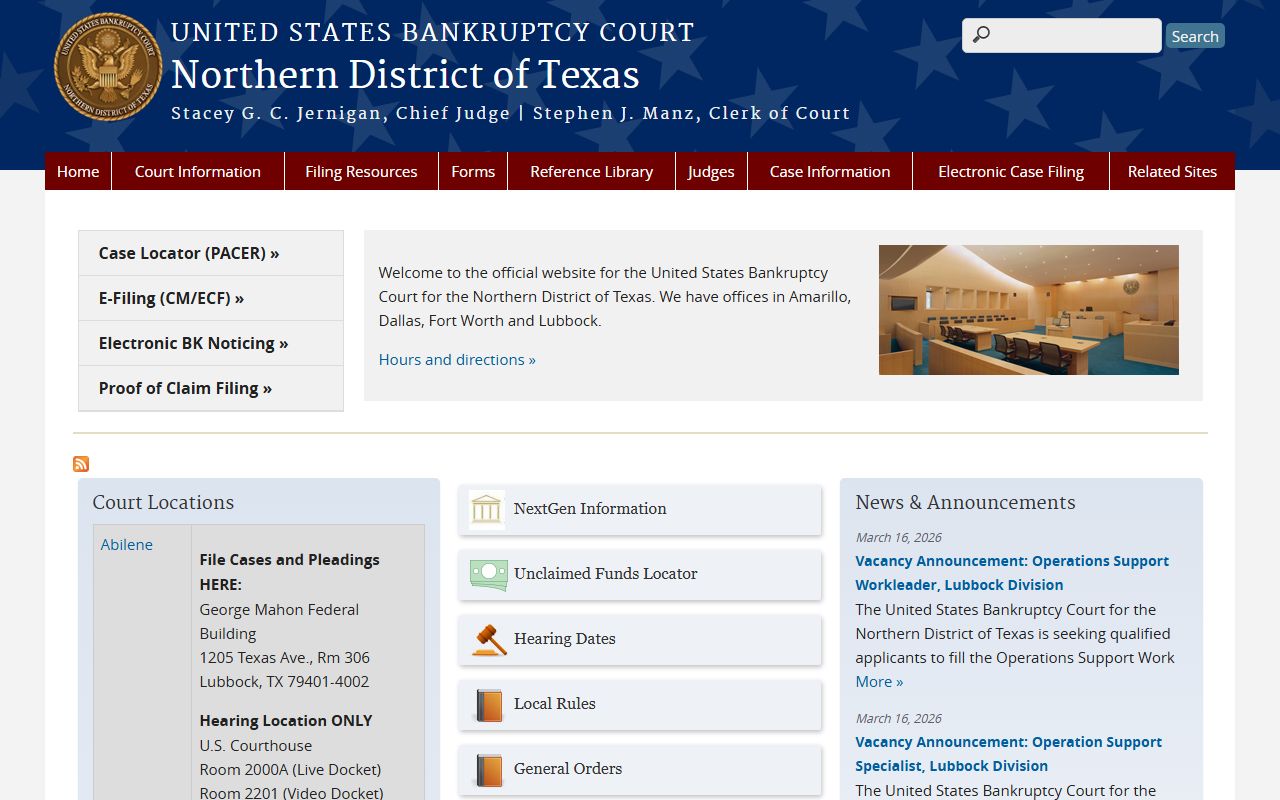
The Northern District also maintains offices in Fort Worth, Amarillo, Lubbock, Abilene, San Angelo, and Wichita Falls to serve residents spread across the large geographic area it covers.
What Texas Bankruptcy Records Contain
Bankruptcy records in Texas are detailed court filings. They lay out the debtor's full financial picture at the time of filing. Under 11 U.S.C. § 107, papers filed in a bankruptcy case and the court dockets are public records open to inspection. Anyone can examine them at the courthouse or through PACER. Courts can restrict access in limited cases involving trade secrets or a real risk of identity theft, but the core filings are generally open.
A typical Texas bankruptcy file includes the debtor's name and address, sources of income, gross income amounts, bank accounts, real estate holdings, and business interests. The file also shows a complete list of creditors, both secured and unsecured, with the amounts owed to each. Filing date, case type, discharge date, and case status are all part of the record. You can also see the trustee assigned to the case, the debtor's attorney, and details about the 341 Meeting of Creditors.
Federal Rules of Bankruptcy Procedure Rule 9037 requires that certain personal identifiers be redacted from public filings. Full Social Security numbers appear as only the last four digits. Dates of birth show only the year. Financial account numbers display just the last four digits. Under 11 U.S.C. § 112, the names of minor children do not appear in public court documents. These privacy rules apply to all Texas bankruptcy records across all four districts.
Note: Bankruptcy records are federal documents. You do not need to be a party to the case to access them. The court clerk can assist you in finding and copying records.
The Southern District of Texas Bankruptcy Court in Houston is one of the most active bankruptcy courts in the country, handling tens of thousands of cases each year.
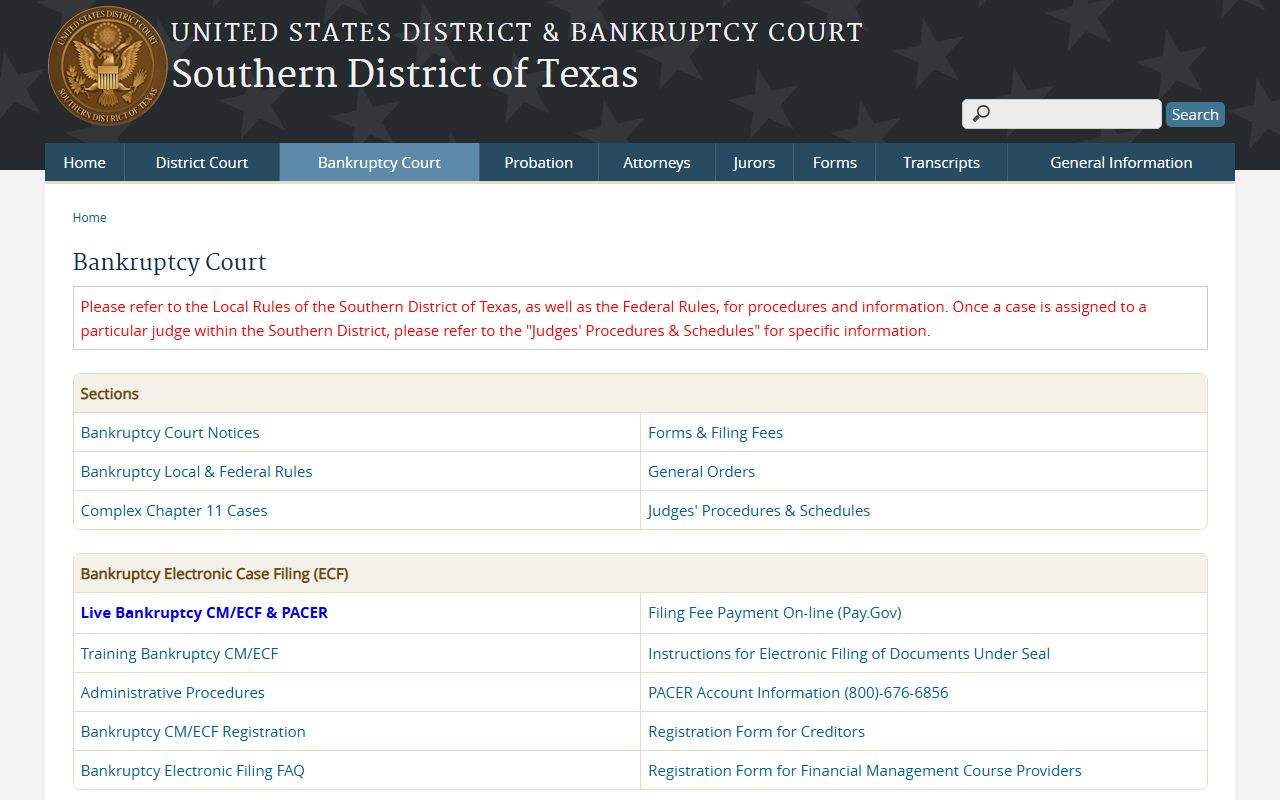
The Southern District serves Harris County, the Gulf Coast, the Rio Grande Valley, and the Laredo area, covering a wide range of communities from major metro centers to rural Gulf Coast counties.
Types of Bankruptcy Cases in Texas
Texas bankruptcy records are filed under different chapters of the federal Bankruptcy Code. Each chapter serves a different purpose. Chapter 7 is the most common. It involves liquidation. The bankruptcy trustee reviews the debtor's assets, sells non-exempt property, and pays creditors from the proceeds. Most Chapter 7 cases in Texas end in a discharge, which releases the debtor from the legal obligation to pay most of the listed debts. The whole process usually wraps up in a few months.
Chapter 13 lets individuals with regular income keep their property and pay creditors over a three to five year plan. The debtor proposes a repayment schedule and the court approves it if it meets Bankruptcy Code requirements. This chapter is often chosen by people trying to stop a foreclosure or catch up on past-due car payments while keeping the property.
Chapter 11 is mainly used by businesses, though individuals with very high debt can also file. It lets the debtor keep operating while putting together a reorganization plan negotiated with creditors. These cases can run for years and often have large volumes of filed documents. Some of the most significant corporate bankruptcy cases in Texas history were filed under Chapter 11 in the Northern and Southern Districts.
Chapter 12 applies to family farmers and family fishermen. It works like a blend of Chapter 11 and Chapter 13, giving agricultural debtors a more flexible path to restructure debt tied to seasonal income. These cases are less common but matter to rural Texas communities where farming is central to the local economy.
The Eastern District of Texas Bankruptcy Court, headquartered in Tyler, covers 43 counties across the eastern part of the state including the Piney Woods and Gulf Coast border region.
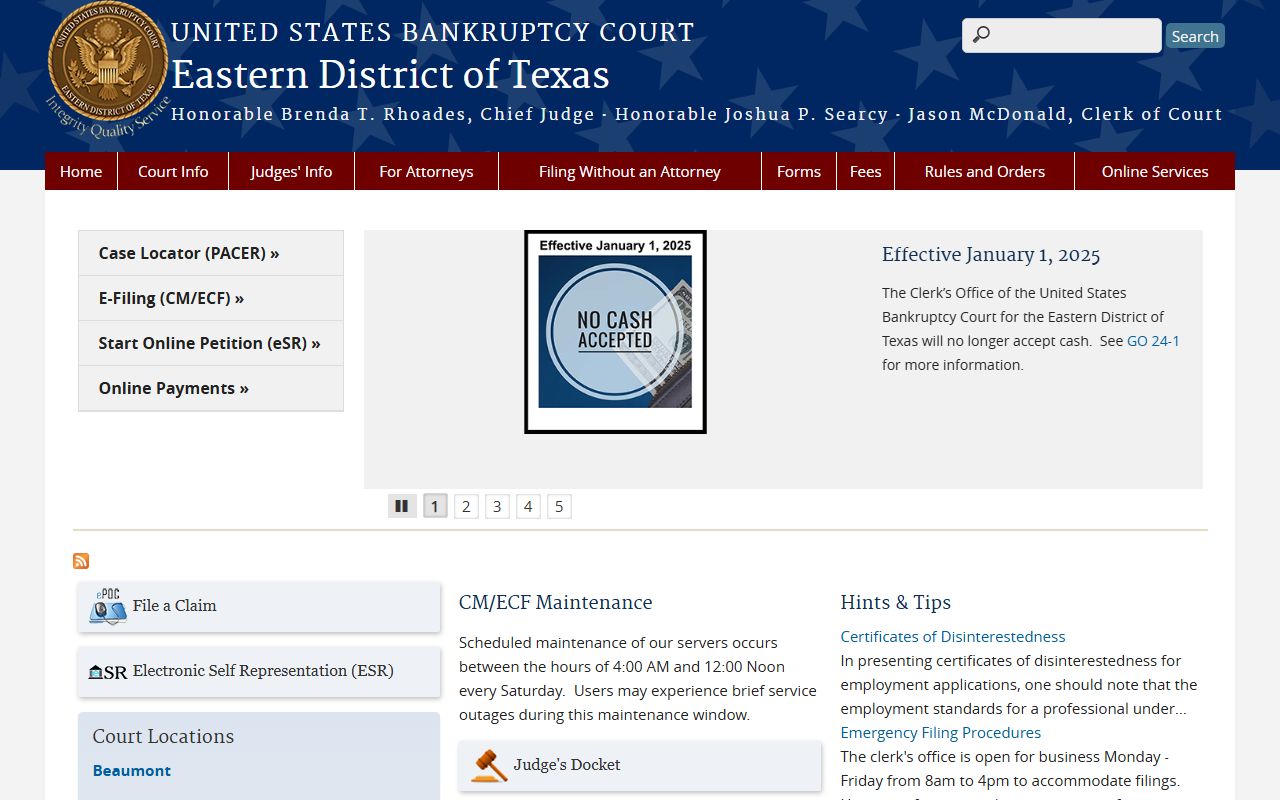
As of June 2025, the Eastern District uses Cisco Webex for all video and teleconference proceedings. Parties seeking to appear by phone at an in-person hearing must contact the appropriate courtroom deputy at least 48 hours in advance.
Federal Law and Public Access to Bankruptcy Records
Access to bankruptcy records is set by federal law. 11 U.S.C. § 107 states that papers filed in a bankruptcy case and court dockets are public records open to examination at reasonable times without charge. A court can seal records when a party shows good cause, such as protecting trade secrets or guarding against identity theft, but that is the exception. Most filings stay public.
The U.S. Trustee Program oversees bankruptcy administration across Texas. Two regions cover the state. Region 6, based in Dallas at 1100 Commerce Street, Room 976, serves the Northern and Eastern Districts. The Regional U.S. Trustee is William T. Neary. Region 7, based in Houston at 515 Rusk Street, Suite 3516, phone (713) 718-4650, serves the Southern and Western Districts. Regional U.S. Trustee Richard W. Simmons heads that office. These offices appoint trustees, monitor cases, and make sure parties follow the rules.
Bankruptcy courts are not run by Texas state government. They are units of the federal judiciary, established under 28 U.S.C. § 151. The U.S. Courts website has guidance on finding federal cases by PACER or in person at a clerk's office. Federal cases are maintained electronically. Older paper records may require a visit to a Federal Records Center or a written request to the National Archives.
Texas has its own public records law for state agencies. Texas Government Code § 552.021 defines what counts as public information held by state governmental bodies. That law doesn't cover federal court records, but it can apply to state or county records that relate to bankruptcy proceedings, such as property deeds affected by a bankruptcy filing.
Note: Federal Rules of Bankruptcy Procedure Rule 5003 requires clerks to maintain a full docket of all papers filed, ensuring a complete record is always available for public inspection.
The Western District of Texas Bankruptcy Court is headquartered in San Antonio and serves 68 counties across central and western Texas, from the Hill Country to the Trans-Pecos region.
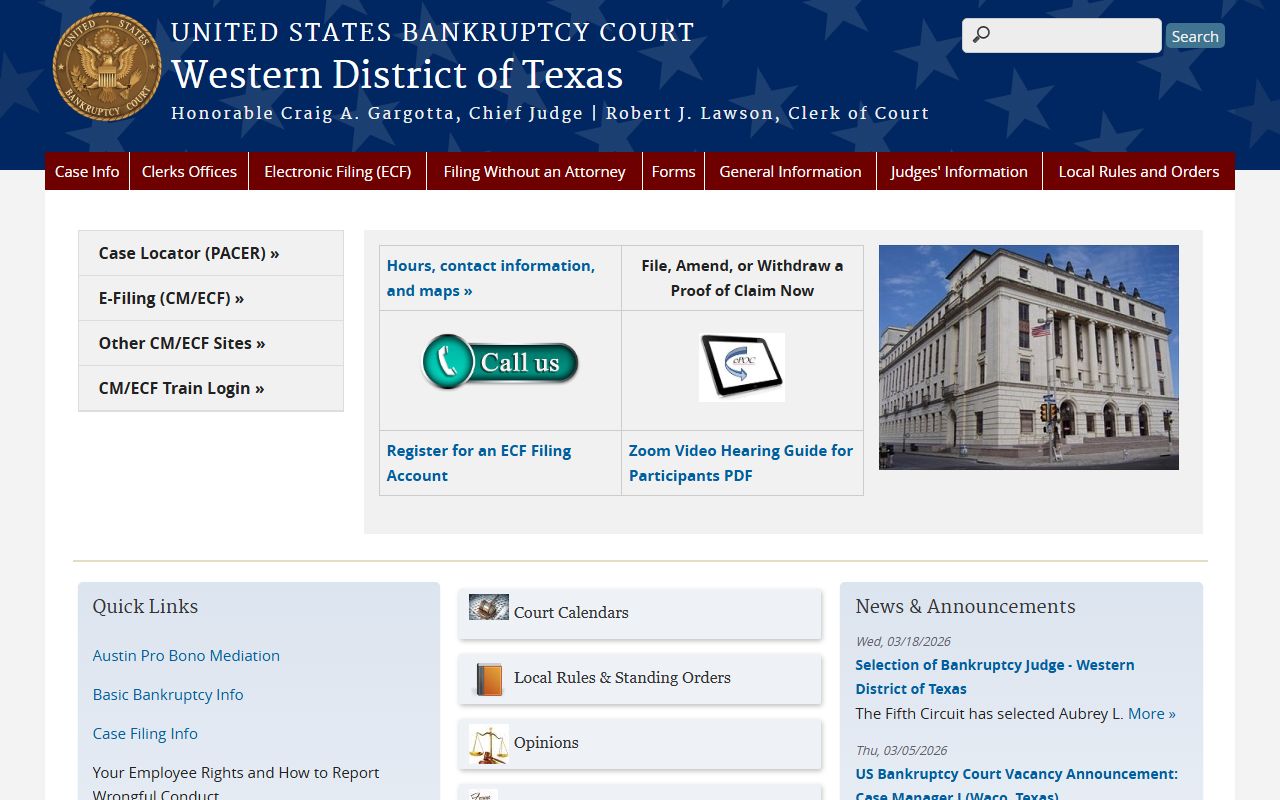
The Western District's Austin division clerk can be reached at 512-916-5237, the Waco office at 254-750-1513, and the El Paso office at 915-779-7362, each serving a distinct region of this large district.
Fees for Searching Texas Bankruptcy Records
PACER is the main way to get Texas bankruptcy records online. The cost is $0.10 per page. The cap per document is $3.00. Transcripts do not have a cap and are also charged at $0.10 per page. Opinions are always free on PACER. Users whose quarterly charges stay under $30.00 get those fees waived automatically. That means casual users who search a few cases here and there may owe nothing at all.
Fee exemptions are available for certain groups. Courts, federal agencies, and bankruptcy trustees get full access at no charge. Academic researchers working on defined scholarly projects can request a fee waiver from the court. The Federal Judicial Center also provides its Integrated Database free of charge for research purposes. This database has case-level data on bankruptcy filings, including filing dates, case types, outcomes, and other key facts, without charging the per-page PACER fee. It does not include full document images.
If you want to look up filing statistics rather than individual cases, the U.S. Courts bankruptcy statistics page has filing counts by district, chapter type, and year. These reports cover all four Texas districts and are updated quarterly and annually. They are free to access and can help you understand how many cases are filed and what types are most common in your area.
The Federal Judicial Center's Integrated Database provides free case-level data on Texas bankruptcy filings across all four districts, useful for research and narrowing down record searches.
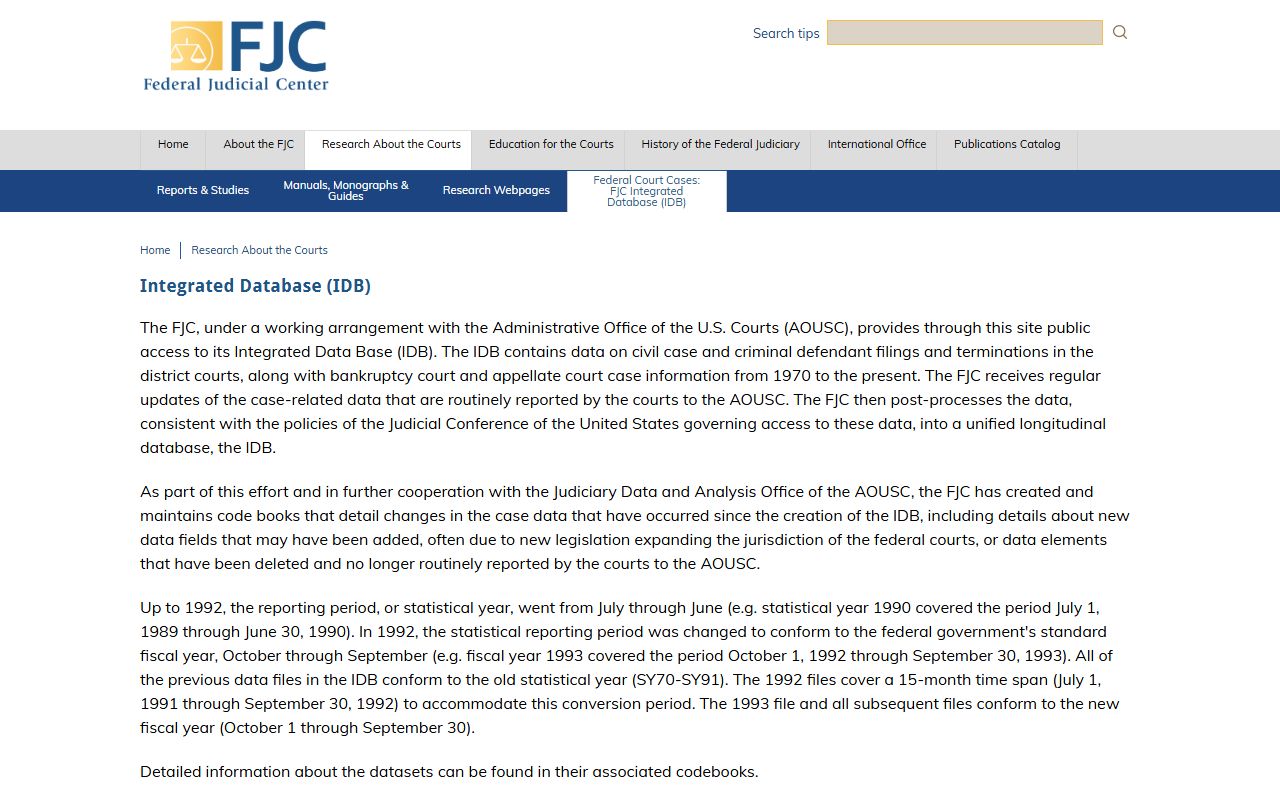
The IDB is a research tool, not a document repository. Use it to identify the case number and district, then retrieve the actual documents through PACER or the clerk's office.
Historical and Archived Texas Bankruptcy Records
Old Texas bankruptcy records can be harder to locate. Cases filed before electronic filing systems were in place, roughly before 1999, were handled on paper. Those files may still be at the courthouse that handled the case. If they've been transferred for storage, they're at a Federal Records Center. When records are designated for permanent preservation, they go to the National Archives and Records Administration. NARA holds federal court records going back to 1898, and the Fort Worth facility is the primary regional archive for Texas federal court records.
To access NARA records, you can search the online National Archives Catalog or contact the Fort Worth facility directly to ask what's available and how to order copies. Some older records are in off-site storage and require advance notice for retrieval. The process takes more time than pulling a recent electronic case from PACER, but these records are preserved and accessible.
The National Archives preserves historical federal court records from Texas, including bankruptcy case files going back more than a century.
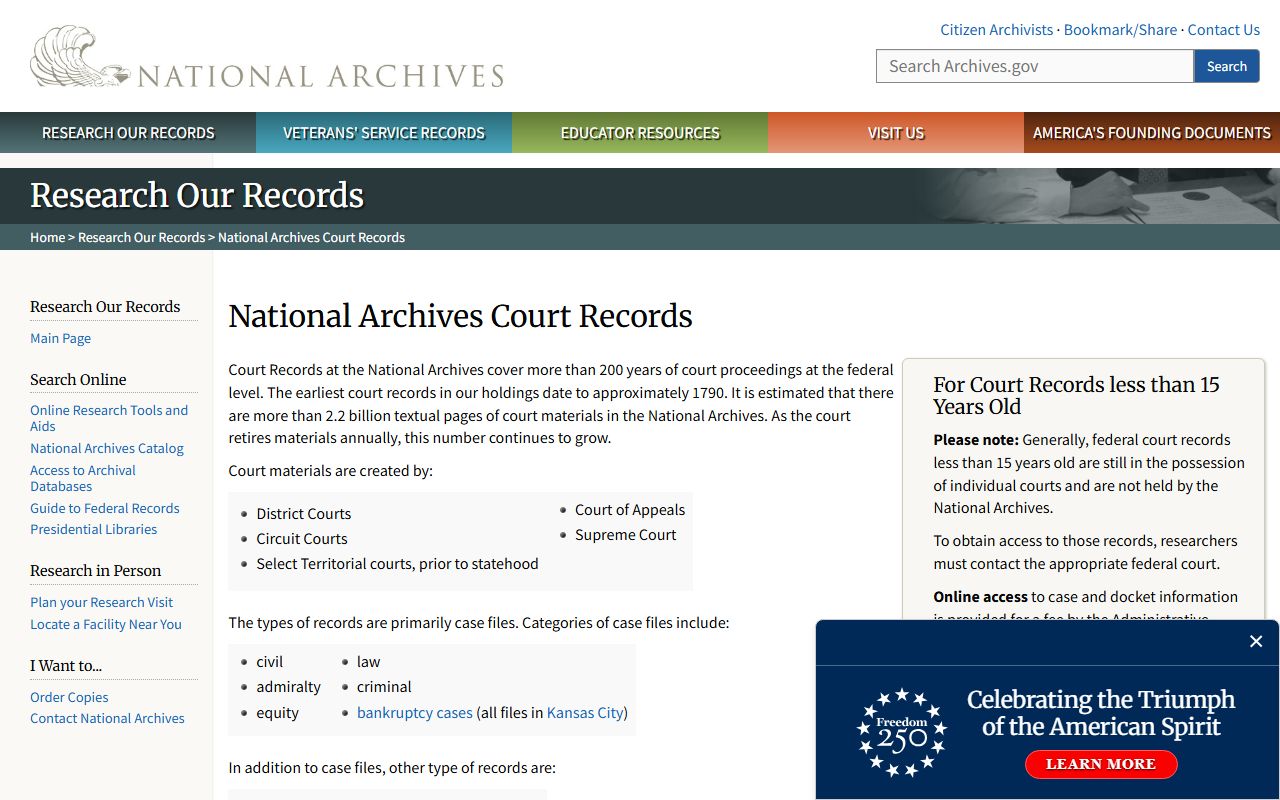
Researchers looking for pre-1999 Texas bankruptcy cases can use the NARA online catalog at archives.gov to search holdings and submit a request for copies from the Fort Worth regional facility.
The full text of 11 U.S.C. § 107 at Cornell Law School's Legal Information Institute outlines the public access rules that govern all Texas bankruptcy filings.
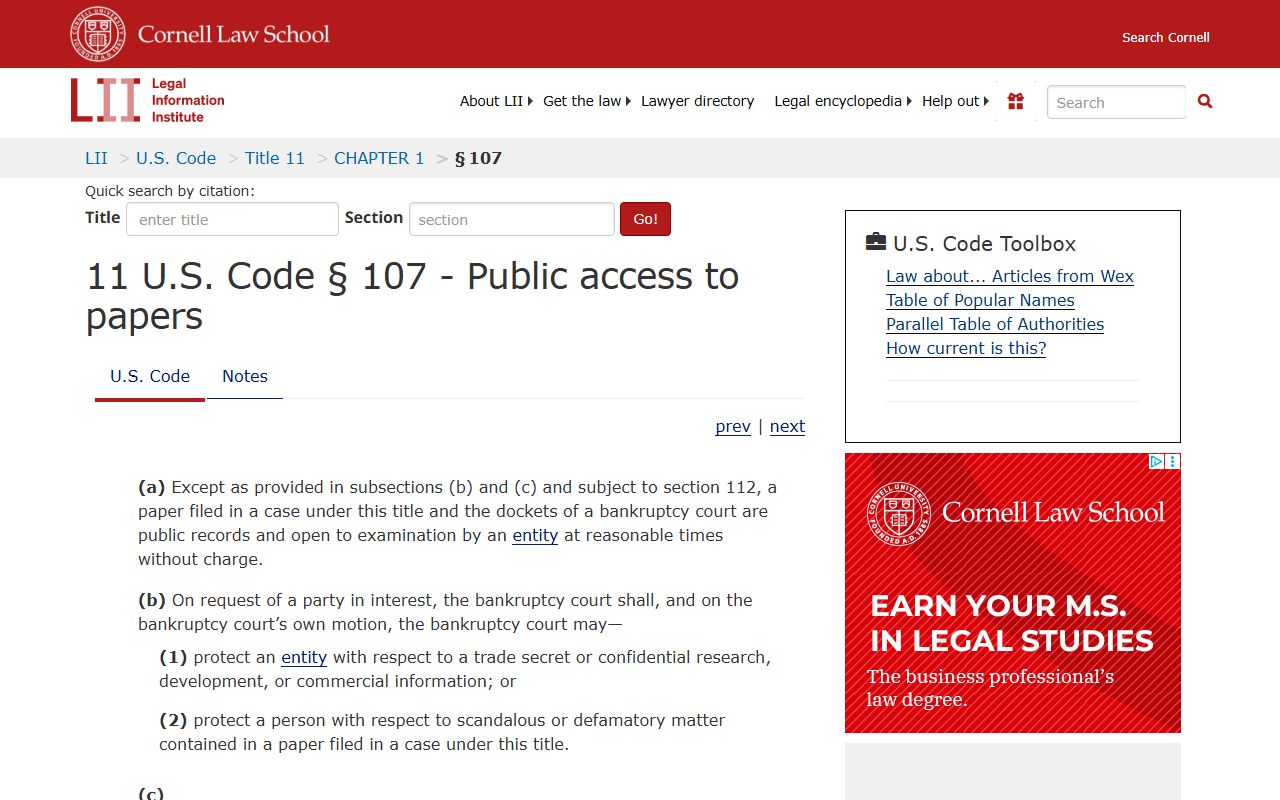
This statute was amended in 2005 by the Bankruptcy Abuse Prevention and Consumer Protection Act, adding the current privacy protections for personal identifiers while preserving broad public access to case documents.
Browse Texas Bankruptcy Records by County
All 254 Texas counties fall under one of the four federal bankruptcy districts. Select a county below to find the court that serves it, local office details, and resources for searching bankruptcy records in that area.
Find Texas Bankruptcy Records by City
Major Texas cities file bankruptcy cases in the federal court that serves their county. Pick a city below to find courthouse details, search tools, and resources for bankruptcy records in that area.