
Anderson County Bankruptcy Records
Anderson County bankruptcy records are federal court filings held by the Eastern District of Texas Bankruptcy Court, Tyler Division. Residents of Palestine and the rest of Anderson County file their cases in Tyler. You can search these records through PACER or call the Voice Case Information System for free basic case data. This page covers where to search, how the filing process works, and what local resources are available to help you get the information you need.
Anderson County Overview
Anderson County Bankruptcy Court
Anderson County is served by the Eastern District of Texas Bankruptcy Court, Tyler Division. This court handles all Chapter 7, Chapter 13, Chapter 11, and Chapter 12 cases filed by residents of Anderson County. The Tyler Division also covers Cherokee, Gregg, Henderson, Panola, Rains, Rusk, Smith, Van Zandt, and Wood counties. Judge Joshua P. Searcy presides over cases from the Tyler Division, with hearings conducted in Tyler.
The Tyler courthouse is the physical location for in-person filing and hearings. If you need to file documents, visit the clerk's office there. The court also accepts the Electronic Self-Representation (eSR) portal for pro se filers, which lets you submit forms online without coming in. Payment methods include cashier's checks and money orders made payable to "Clerk, U.S. Bankruptcy Court." The court also accepts cash.
| Court | Eastern District of Texas Bankruptcy Court, Tyler Division |
|---|---|
| Address | 211 West Ferguson Street, Room 106, Tyler, TX 75702 |
| Phone | (903) 590-3200 |
| Website | txeb.uscourts.gov |
| VCIS | 866-222-8029 |
The U.S. Trustee for Anderson County cases operates through the Tyler field office. The office at 110 N. College Avenue, Room 300, Tyler, TX 75702 can be reached at (903) 590-1450. The U.S. Trustee, part of Region 6 based in Dallas, appoints and oversees bankruptcy trustees who run Chapter 7, 12, and 13 cases. They also check that petitions follow the Bankruptcy Code.
Note: The Tyler Division serves a broad area of East Texas, so check that your county is Anderson before filing there.
The Anderson County Government website provides access to property records and county office information that may be relevant to your bankruptcy case.
The county clerk's office in Palestine maintains deed records and real property data. These records can show liens or transfers tied to bankruptcy proceedings in Anderson County.
How to Search Anderson County Bankruptcy Records
The main tool for searching Anderson County bankruptcy records is PACER, the federal court's Public Access to Court Electronic Records system. PACER gives you full docket access, case filings, court orders, and documents for all bankruptcy cases in the Eastern District. You need to create a free account to search. There is a per-page fee for viewing documents, though many basic searches are free.
If you just need basic case info, the Voice Case Information System (VCIS) at 866-222-8029 is free to use. Call and enter a case number or a Social Security number to hear a recorded summary of the case. VCIS does not give you documents, but it confirms whether a case exists and gives you its status.
Under 11 U.S.C. § 107, most bankruptcy records are public. Anyone can look them up. Some personal details like full Social Security numbers are redacted under Federal Rule of Bankruptcy Procedure 9037 to protect privacy, but the bulk of the case record is open.
You can also visit the Tyler courthouse in person and use a public terminal to search PACER at no charge. Bring a case number or a party name. Staff can help you find the file and make copies.
The Eastern District of Texas Bankruptcy Court forms and procedures page lists all required local forms for Anderson County filers.
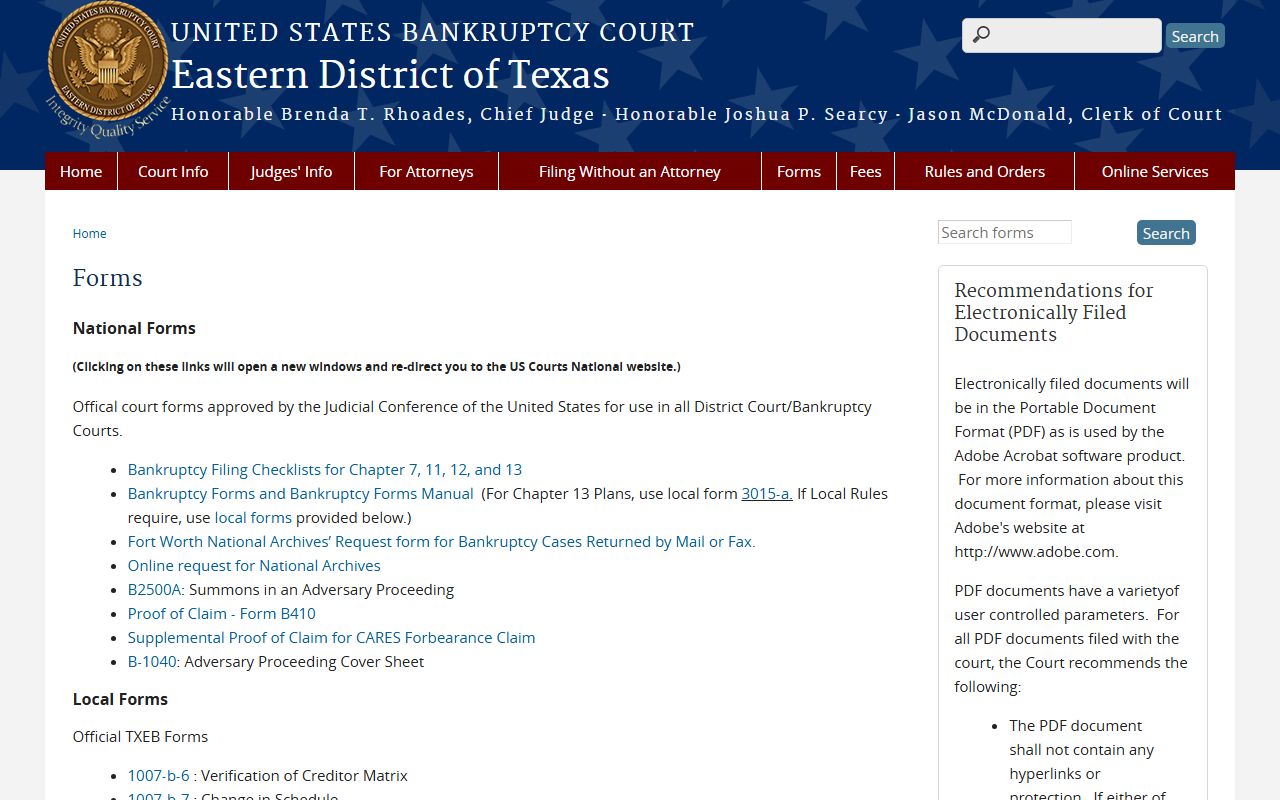
Anderson County residents must follow specific local rules when filing, including photo ID submission and creditor matrix requirements outlined on this court page.
Filing Bankruptcy in Anderson County
To file bankruptcy in Anderson County, you go through the Eastern District of Texas, Tyler Division. All filings use federal forms. Chapter 7 is a liquidation case where a trustee sells non-exempt assets to pay creditors, and most remaining debt is discharged. Chapter 13 is a repayment plan, usually lasting three to five years. These are the two most common types for individuals.
The Eastern District has specific local requirements. You must list creditors alphabetically on Schedules D and E/F. You must submit a copy of your photo ID enlarged to 150% of actual size to the case trustee at least seven days before your 341 meeting (the meeting of creditors). You also need to attach a Verification of Matrix form as the last page of your creditor matrix. The court's local forms page has all the required documents.
Filing fees apply in all cases. If you cannot afford the full fee, you can ask to pay in installments. The initial payment must be at least $75 when filing. You can also request a fee waiver if your income is below 150% of the federal poverty level. The court reviews these requests.
Federal Rule of Bankruptcy Procedure 5003 requires courts to keep a public record of all cases. This means your filing date, case number, and case status are part of the public record from the moment you file.
Note: The preferred filing method for pro se filers (those without an attorney) is the Electronic Self-Representation (eSR) portal on the court's website.
Anderson County Resources
The Anderson County Clerk's office in Palestine handles real property records, deed records, and other county documents. These records can be useful in a bankruptcy case when you need to show what property you own or what liens exist. The office is at 703 N. Mallard Street, Palestine, TX 75801. The county also has a District Clerk reachable at (903) 723-7400 for state court records.
Bankruptcy records contain detailed financial information. A typical case file includes your list of assets and their values, your debts and creditors, your income and monthly expenses, any property you claim as exempt, and a record of all payments made in the 90 days before filing. These details come from the schedules and statements you file with the court.
If you need legal help, East Texas Legal Services provides free or low-cost assistance for qualifying individuals. You can also contact the State Bar of Texas lawyer referral service and look up attorneys through the Northern District or Eastern District's attorney lookup tools. The U.S. Bankruptcy Court for the Eastern District also has self-help resources on its website.
Nearby Counties
These counties are in or near the Eastern District of Texas and file bankruptcy cases in Tyler or nearby divisions.