
Find Bankruptcy Records in Andrews County
Andrews County bankruptcy records are federal filings handled by the Western District of Texas Bankruptcy Court through the Midland-Odessa Division. Residents of Andrews file cases in this division, which covers the oil-patch counties of West Texas. You can search records through PACER or get basic case data free from the court's phone line. This page explains where the court is located, how to search, and what county offices can help with related records.
Andrews County Overview
Andrews County Bankruptcy Court
Andrews County is served by the Western District of Texas Bankruptcy Court, Midland-Odessa Division. The Midland-Odessa Division is an unstaffed division, which means there is no permanent clerk's office at the local level. Cases are administered through the Austin or San Antonio offices. The Austin division clerk's office handles Midland-related matters and can be reached at (512) 916-5237. The San Antonio main office is at (210) 472-6720.
Andrews County is in the division alongside Crane, Ector, Martin, Midland, and Upton counties. All of these West Texas counties share the same division. Hearings may be held in Midland or Odessa at the court's discretion. If you have a hearing scheduled, check the notice you receive from the court to confirm the location.
| Court | Western District of Texas, Midland-Odessa Division |
|---|---|
| Division Type | Unstaffed (administered via Austin/San Antonio) |
| Austin Office | (512) 916-5237 |
| San Antonio Office | (210) 472-6720 |
| Website | txwb.uscourts.gov |
The U.S. Trustee for Andrews County is part of Region 7, administered from Houston with a field office in San Antonio at 615 E. Houston Street, Suite 533, San Antonio, TX 78205, phone (210) 472-4640. Assistant U.S. Trustee Nancy Ratchford oversees this office. The Trustee appoints case trustees and monitors compliance with the Bankruptcy Code for all Andrews County cases.
The Andrews County Government website provides access to county records and official public information relevant to bankruptcy filings.

The Andrews County Clerk at 201 N. Main St. maintains property and deed records that can show liens or asset transfers connected to bankruptcy cases in the county.
How to Search Andrews County Bankruptcy Records
The main way to search Andrews County bankruptcy records is through PACER. This federal system covers all cases filed in the Western District of Texas. You can search by debtor name, case number, or Social Security number. PACER shows you case summaries, docket entries, filed documents, and orders. Create a free account at pacer.uscourts.gov to get started. There is a small per-page fee for documents.
Under 11 U.S.C. § 107, bankruptcy filings are public records. Anyone can view them. The only items that are sealed or redacted are those that include sensitive personal data protected under Federal Rule of Bankruptcy Procedure 9037, such as full Social Security numbers and financial account numbers. The rest of the file is open to public review.
Since the Midland-Odessa Division is unstaffed, there is no local public terminal in Andrews. You would need to travel to Austin or San Antonio to use a courthouse terminal, or access PACER online from any computer. Calling the court offices in Austin or San Antonio can also give you basic case status by phone.
Note: Always confirm the correct division before filing. Residents of Andrews County use the Midland-Odessa Division, not the San Antonio or Austin divisions directly.
The Western District of Texas local rules and forms page lists all required documents Andrews County residents must submit when filing bankruptcy.
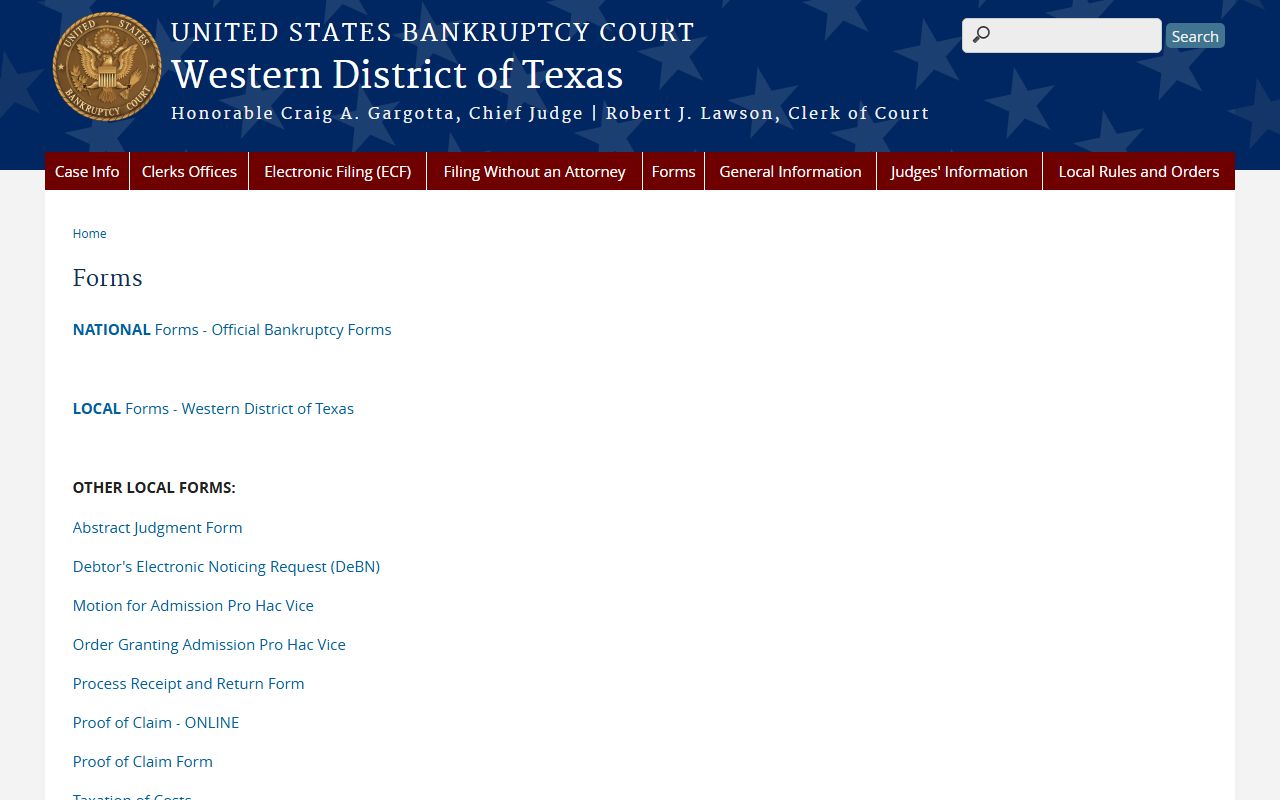
Local rules for the Western District include creditor matrix requirements, Pro Se Questionnaire submission, and specific payment rules for installment filers in Andrews County.
Filing Bankruptcy in Andrews County
Filing bankruptcy in Andrews County follows Western District of Texas procedures. You bring or mail one original and one copy of your bankruptcy forms to the Austin or San Antonio office since the Midland-Odessa Division is unstaffed. You must complete a Pro Se Questionnaire and create a creditor matrix listed in alphabetical order with a Verification of Matrix form attached as the last page.
Chapter 7 and Chapter 13 are the most common types for Andrews County residents. Chapter 7 wipes out eligible unsecured debt after a trustee reviews your assets. Chapter 13 sets up a payment plan where you pay back some or all of what you owe over three to five years. Chapter 11 is available too, mostly used by businesses.
Filing fees apply. If paying in installments, you must pay at least 50% of the filing fee, which is $169, within seven days of filing. The court takes cashier's checks or money orders payable to "Clerk, U.S. Bankruptcy Court." The San Antonio office accepts cash with exact change. Cash is not accepted at the Austin, El Paso, or Waco offices.
Federal Rule of Bankruptcy Procedure 5003 requires the court to maintain a public record of every filing. From the day you file, your case number, debtor name, and case status become part of the public record.
Andrews County Local Resources
The Andrews County Clerk is located at 201 N. Main St., Andrews, TX 79714, and can be reached at (432) 524-1425. The clerk maintains real property records and deed records. When you file bankruptcy, the trustee may search these records to find property you own in the county. The Andrews County District Clerk handles state court records and can be reached at (432) 524-1460.
A bankruptcy case file typically includes your list of assets and their estimated values, a full list of all debts and creditors, your current income and monthly living expenses, any property you claim as exempt under Texas law, and a 90-day payment history to creditors. These schedules and statements are public once filed.
Texas offers strong exemptions for homesteads, vehicles, and personal property. Andrews County residents should review the Western District's local forms at txwb.uscourts.gov/forms before filing to make sure they claim all available exemptions. Legal aid organizations in West Texas can also help with this process.
Nearby Counties
These counties are also in the Western District of Texas and share the Midland-Odessa Division for bankruptcy filings.